The INSURANCE PARADOX: State Capture, Market Distortions, and the SIC Reset
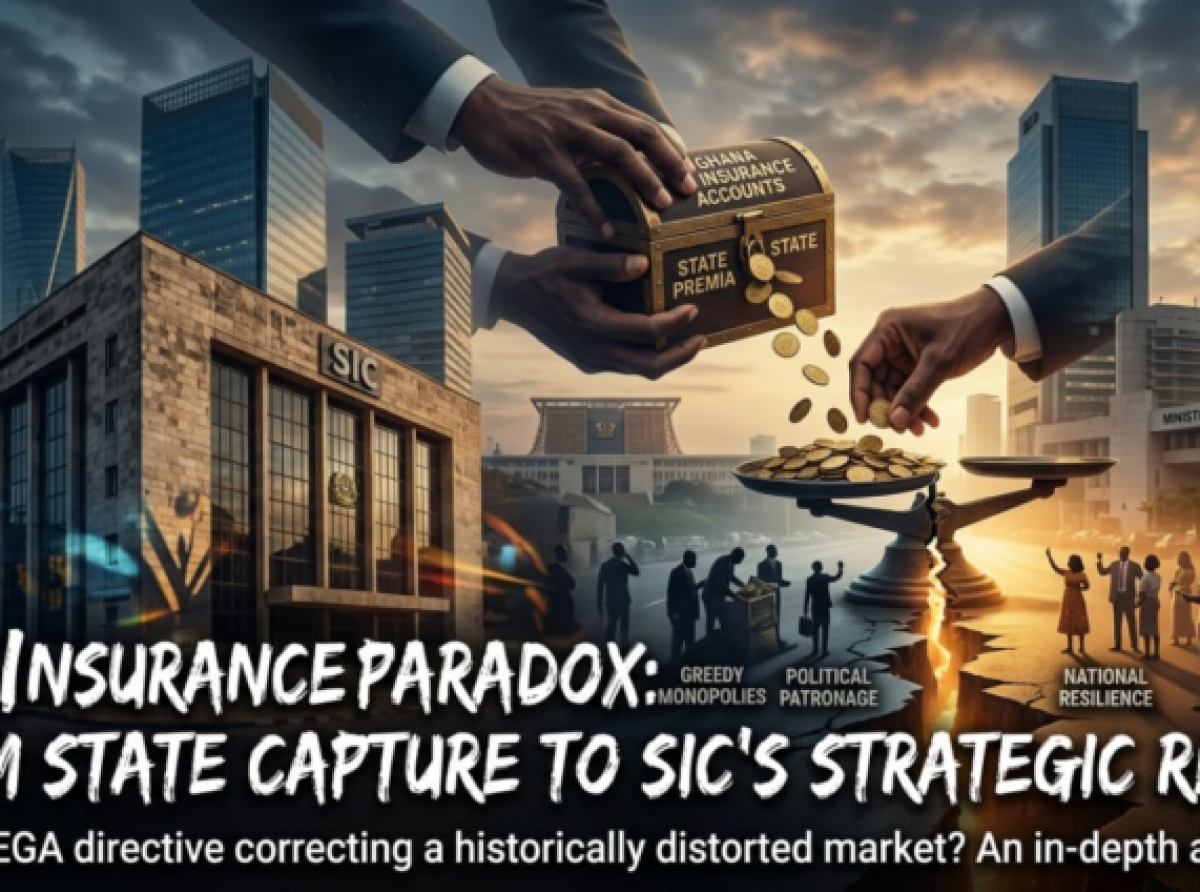
For years, Ghana’s insurance industry has operated less as a truly competitive marketplace and more as a tightly controlled ecosystem shaped by political patronage, selective access, and entrenched interests. Rather than fostering fair competition, the system has often resembled an exclusive network where a privileged few benefit disproportionately from state-linked opportunities.
The recent outcry over alleged “political influence” following directives from the State Enterprise Governance Agency (SEGA) must therefore be examined with a critical lens. Far from representing a genuine push for transparency, these reactions appear to reflect the discomfort of previously advantaged players who are now facing a shift in the status quo. The resistance is less about principle and more about the disruption of long-standing access to state-controlled insurance portfolios.
A look back at the establishment of Ghana National Gas Company in 2014 under John Dramani Mahama offers important context. The creation of the Ghanaian Oil and Gas Insurance Pool was a deliberate and strategic move aimed at protecting national assets and ensuring that insurance value derived from critical sectors remained within Ghana’s financial ecosystem.
However, over the years, this protective framework was gradually weakened. Key regulatory and policy decisions by institutions such as the Ministry of Energy and the Energy Commission shifted the operational positioning of Ghana Gas, effectively eroding the collective safeguards that had been put in place.
Following the 2017 political transition, internal power struggles further complicated the situation. The contest between Boakye Agyarko and Ken Ofori-Atta highlighted the extent to which control over state-linked insurance portfolios had become politicized. Competing interests reportedly sought to channel significant accounts toward specific private insurers, raising concerns about transparency and the prioritization of national interest.
Ironically, some of the same actors who are now advocating for competitive bidding were previously associated with practices that sidelined merit-based processes. Questions remain about how major state-linked premiums—such as those from the Bank of Ghana—were allocated, and whether such decisions adhered to transparent and competitive frameworks.
The broader issue reflects a pattern of systemic imbalance. Through the gradual introduction of intermediaries and brokers into previously state-dominated insurance arrangements, risks and premiums were increasingly redirected toward selected private entities. This shift contributed to the weakening of the State Insurance Company (SIC), a key national institution originally designed to anchor the country’s insurance capacity.
The consequences of this trend extend beyond market competition. As SIC’s role diminished, Ghana’s ability to underwrite complex, high-value risks—particularly in sectors such as oil, gas, and infrastructure—was compromised. This has increased reliance on foreign reinsurance markets, resulting in capital outflows and reduced domestic capacity.
In this context, SEGA’s recent directive should not be viewed as a distortion of the market but rather as a strategic intervention aimed at restoring balance. The move seeks to ensure that state-generated premiums contribute to strengthening national institutions, rather than being concentrated within a narrow group of beneficiaries.
This approach aligns with broader developmental economic principles, where state-backed institutions play a central role in building long-term capacity, supporting industrial growth, and safeguarding national financial interests.
The situation is further complicated by institutional inconsistencies. Entities such as Social Security and National Insurance Trust, despite holding stakes in SIC, have at times opted to place insurance business elsewhere. Such decisions highlight deeper structural and governance challenges that have contributed to SIC’s marginalization.
Ultimately, the current debate is not simply about competition versus state intervention. It is about addressing historical imbalances, restoring institutional integrity, and ensuring that Ghana’s insurance sector serves the broader national interest.
The pushback against reform reflects a broader struggle between entrenched interests and efforts to rebuild equitable systems. The critical question facing policymakers and stakeholders is whether to preserve the gains of a select few or to strengthen institutions that serve the collective good.
SEGA’s intervention represents an opportunity to reset the system—to create a more balanced, transparent, and resilient insurance industry that supports Ghana’s long-term economic development. For SIC and the nation as a whole, this reset is not only necessary but overdue.

Aikines Anyomi

News
Food
Politics
Technology
About Us
Download Our Mobile App

